Why Starting a Small Business Makes Sense in the Age of AI
Most people do not need another frightening headline about AI. They need a practical way to think about what work might look like next.
The job conversation has changed. Warnings about AI are no longer only coming from commentators. They are also coming from the people building, funding and using the technology.
Anthropic CEO Dario Amodei has warned that AI could affect a large share of entry-level white-collar jobs within one to five years.
Amazon CEO Andy Jassy has told employees that wider use of generative AI could mean “fewer people” doing some jobs and may reduce Amazon’s corporate workforce over the next few years.
That does not mean everyone should panic, quit their job or rush into a business they have not tested. It does mean more people are thinking seriously about income resilience.
The grounded takeaway is simple: this is not about leaving your job tomorrow. It is about building optionality.
What AI leaders are actually saying
The messages are not all the same. Some are stark.
Sam Altman has previously said some job categories could be “totally, totally gone”, with customer support often used as an example. More recently, he said he does not expect a full “jobs apocalypse” and that his earlier instincts about near-term job losses were off.
Other business leaders are talking less about sudden replacement and more about efficiency.
Salesforce CEO Marc Benioff has said engineering headcount has stayed broadly flat because AI tools are making teams more productive, while the business is still hiring in sales.
Ford CEO Jim Farley has warned that AI could replace a large share of white-collar work, while arguing that practical, physical and skilled work will still need people.
There also needs to be balance. Stanford Digital Economy Lab says the overall employment effect of AI appears small right now, but there is evidence that AI may be reducing hiring in AI-exposed entry-level roles.
So the better question is not, “Will AI take my job?” It is, “How exposed is my income?”
How exposed is your work?
A role may be more exposed if much of the work is repeatable, digital and easy to describe in steps. That might include drafting standard documents, answering routine queries, summarising information, updating spreadsheets, producing first versions of reports or handling basic admin.
That does not mean the whole job disappears. Often, the risk is less dramatic. Hiring may slow. Junior tasks may be automated. Teams may be restructured. One person may be expected to do more with better tools.
AI may also make your work more productive but less secure. That is a difficult combination. You may be good at your job and still feel that your income depends on decisions outside your control.
This is where a small business can be useful. Not as a magic fix, but as a practical hedge.
Why a small business is a practical hedge
A small business does not have to replace your salary straight away. For most people, that is not the sensible first aim.
A better starting point is a small version you can test: one offer, one type of customer, one simple way to get paid.
That could mean a weekend service, a home-based business, a local offer, a small online service, a creative product, admin support, tutoring, consulting, repairs, food, events, marketing help, bookkeeping support or a trade-adjacent service.
The value is not only extra income. A small business can help you build confidence, understand customers, learn pricing, practise selling, manage costs and see whether self-employment might suit you later.
Small business is not a fringe route either. At the start of 2025, SMEs employed 16.9 million people in the UK, around 60% of total private-sector employment.
What kind of business makes sense in an AI-shaped economy?
AI can write, summarise, plan, calculate and automate parts of many tasks. But it does not remove the need for trust, judgement, taste, customer care, local knowledge, physical delivery or real-world setup.
That creates space for practical businesses such as:
- local services where reliability matters
- home, garden, pet, cleaning, repair or organisation services
- food, craft and creative businesses with a clear customer
- admin, marketing or support services that use AI well
- coaching, tutoring or training with a human relationship
- niche online services built around judgement, clarity or specialist knowledge
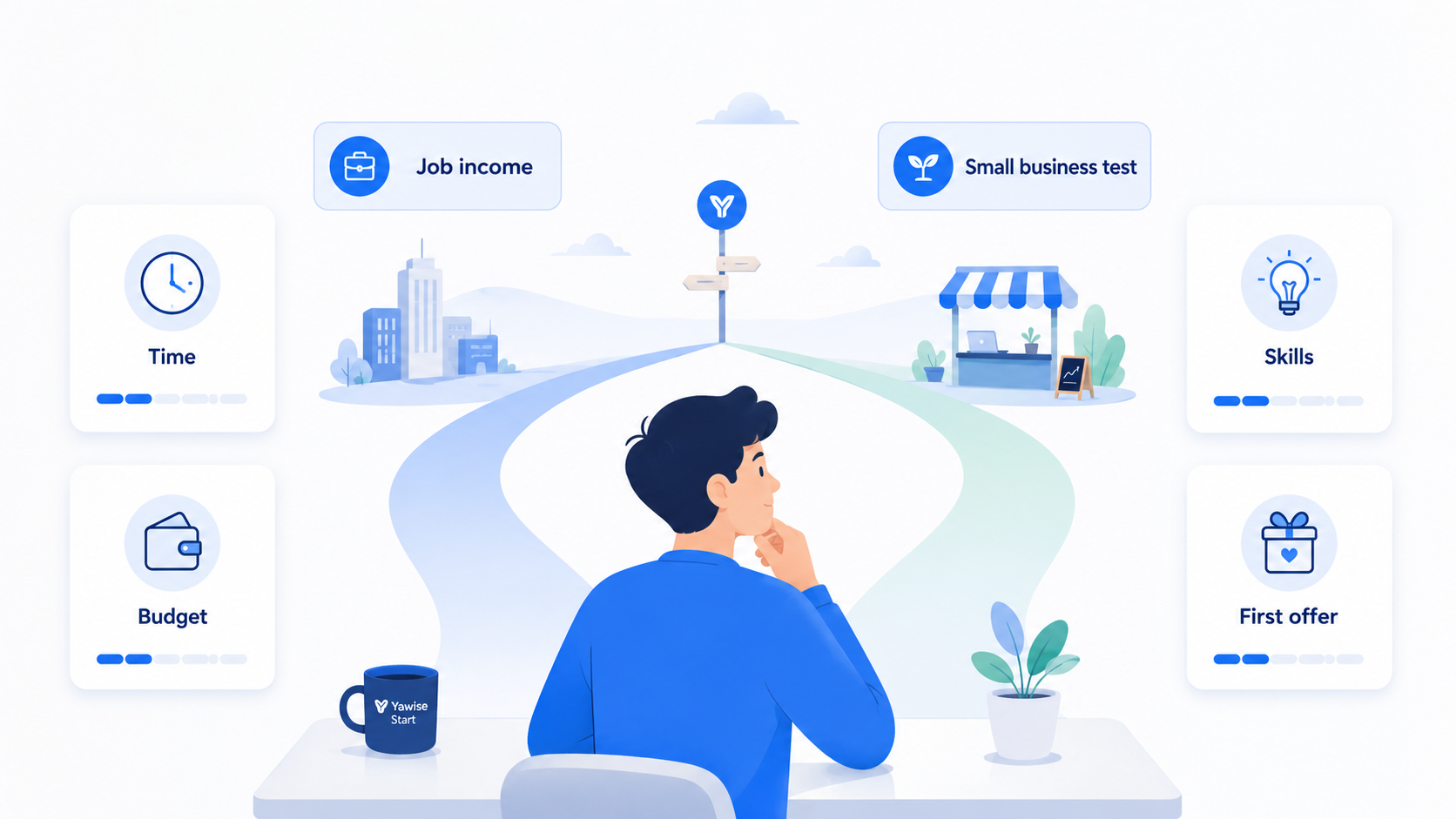
The strongest small business ideas are not always the most original. They are often the ones that fit your time, budget, skills, confidence and route to a first customer.
Start small, not dramatic
The worst response to uncertainty is to make an expensive, rushed decision.
You do not need to quit your job to “go all in”. You do not need to spend thousands before testing demand. You do not need a perfect logo, full website and daily social media plan before you know what you are selling.
Start with the basics:
- What problem will you solve?
- Who will you help?
- What will you charge for the first version?
- How will someone enquire or book?
- What do you need before you can safely and legally start?
Some business types may need qualifications, licences, insurance or specialist approval before you begin. This is a practical starting point, not legal, tax or financial advice, so check the latest rules before you launch.
Your next sensible step
You do not need to know everything yet. You do need a first step that fits your real life.
If you are not sure what kind of business would suit your time, budget, skills and confidence, start with the Business Idea Finder. It can help you narrow your options instead of staring at a huge list of ideas.
Once you have an idea, a Launchpad can help you work through the setup: your first offer, pricing, costs, customer process, messages and first promotion.
AI may change work quickly, slowly or unevenly. No one can predict it perfectly. But building a small, realistic business test can give you more options, without panic, hype or pretending you have everything figured out.