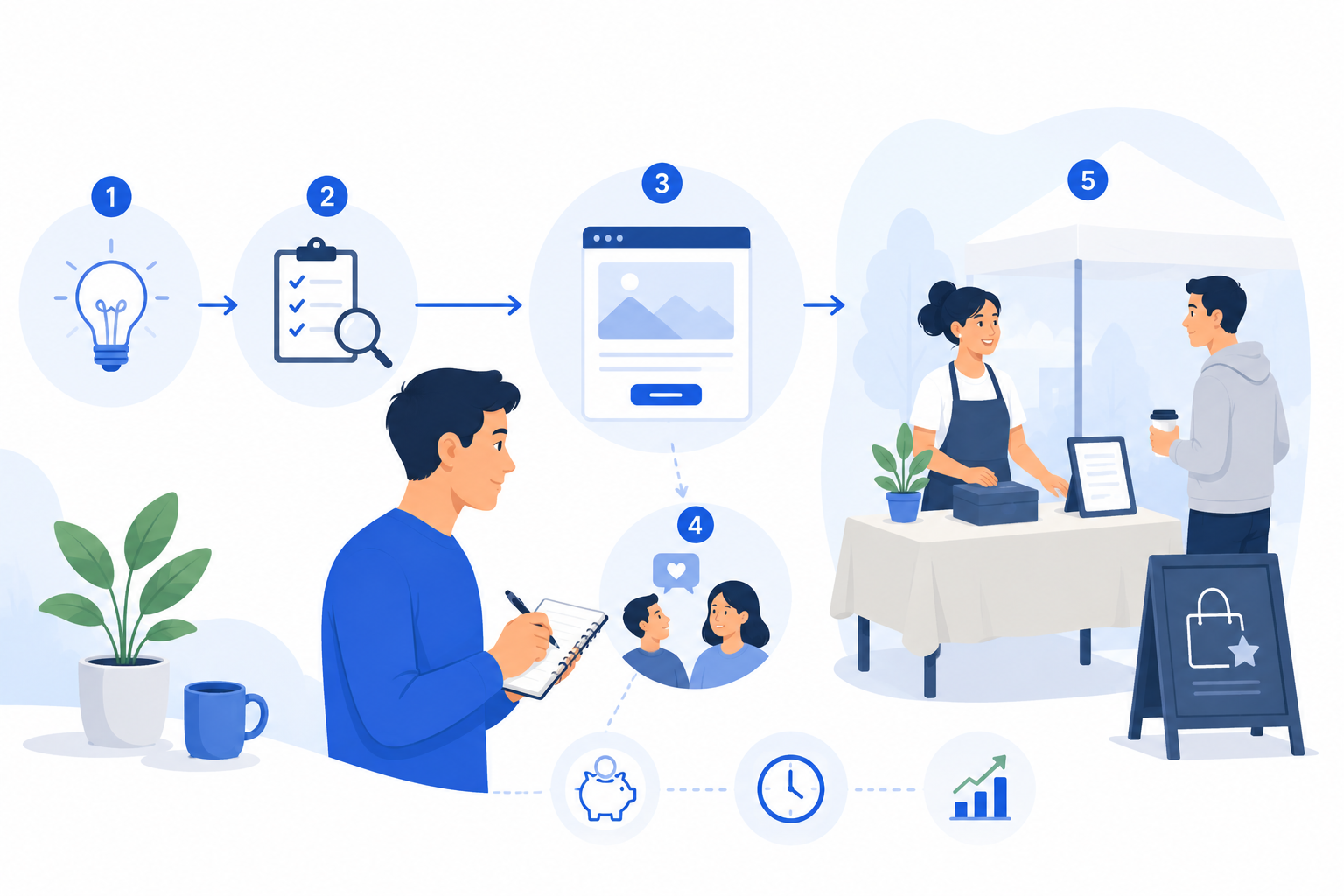
You do not need to build the perfect business before you know whether anyone wants it.
In fact, that is often where people waste money. They spend on logos, websites, stock, equipment, packaging, adverts and software before they have tested the most important thing: will someone actually pay for this?
The first step is usually a small, safe test.
A good test helps you find out whether people understand the offer, whether the problem matters to them, and whether they are willing to take the next step.
Define the smallest version of the idea
Start by making the idea smaller.
Not the full business. Not the final brand. Not every possible service or product.
Just the smallest version you can safely and clearly offer.
That might mean:
- one service
- one product
- one customer type
- one price or price range
- one simple way to enquire or order
- one clear delivery method
For example, instead of launching a full home organisation business, you might test “one-off cupboard and paperwork organisation sessions for busy households”.
Instead of starting a full bakery brand, you might test “Friday cupcake boxes by pre-order for local collection”.
Instead of offering general marketing support, you might test “one-month social media scheduling support for local salons”.
The aim is not to limit yourself forever. It is to make the first test clear enough for people to understand.
Write your first offer in plain English
If you cannot explain the offer simply, customers may struggle to buy it.
Use this template:
I help [type of person] with [problem] by offering [simple service or product].
For example:
“I help local trades with missed enquiries by offering weekly inbox and follow-up support.”
“I help busy parents with cluttered spare rooms by offering a three-hour home organisation session.”
“I help small cafes with regular content by offering a monthly pack of social media posts using their own photos.”
“I help dog owners who work long days by offering lunchtime pet visits in my local area.”
Plain English is important. Avoid clever names or vague descriptions at this stage. You can improve the wording later. For now, people need to know who it is for, what problem it solves and what they get.
Estimate the basic startup cost
Before you spend anything, write down what you would actually need to deliver the first version.
Depending on the business, this might include:
- equipment
- software
- materials
- insurance
- local checks
- transport
- packaging
- payment tools
- licences or registration
- safety items
- basic marketing materials
Separate “must have before serving a customer” from “nice to have later”.
For example, insurance may be essential before entering someone’s home. Food hygiene requirements may matter before selling food. Suitable tools may be needed before offering repair work.
A logo, branded clothing, a full website or a large batch of stock may not be needed for the first test.
The goal is to spend only what is necessary to test safely and properly.
Check the boring-but-important rules early
Some business ideas need more checks before you test them.
This is especially true for businesses involving:
- food
- care
- childcare
- beauty
- finance
- animals
- transport
- health or wellbeing
- entering customers’ homes
- storing customer data
- regulated advice or services
Depending on the idea, you may need insurance, qualifications, licences, hygiene checks, DBS checks, risk assessments, permissions or professional advice.
This is a practical starting point, not legal, tax, insurance or financial advice. Check the latest rules before you launch, and speak to a relevant professional if your business type needs it.
Do this early. It is better to find out before you spend money on packaging, adverts or equipment.
Ask for interest before investing heavily
Once your small offer is clear, ask for interest.
You are not trying to convince everyone. You are trying to see whether the right people understand the offer and want to know more.
Ways to test include:
- messaging people who fit the customer type
- posting carefully in a local group, where allowed
- asking past contacts for honest feedback
- sharing a simple enquiry form
- creating a basic landing page
- offering a limited trial
- taking pre-orders, where suitable and safe
- asking people what would stop them buying
For example, you might say:
“I’m testing a local garden tidy-up service for small front gardens. The first version would be a two-hour session with basic weeding, sweeping and light tidying. Would this be useful, and what would you expect to pay?”
Or:
“I’m testing a monthly inbox support service for sole traders who miss customer enquiries. It would be two hours a week to organise messages, flag urgent replies and track follow-ups. Is this something you would consider?”
You are looking for real signals, not just polite encouragement.
Review the signal honestly
People saying “great idea” is nice, but it is not the same as demand.
Look for stronger signs:
- enquiries
- specific questions
- price discussions
- people asking when it starts
- willingness to pay
- repeat interest
- pre-orders
- referrals
- people explaining their problem in detail
Also pay attention to what confuses people.
Did they understand who it was for?
Did they know what was included?
Did the price feel unclear?
Did they ask for something slightly different?
Did they trust you enough to take the next step?
If people are interested but not buying, the idea may still be useful. The offer might need to be clearer, smaller, more specific or aimed at a different customer.
If nobody responds, do not jump straight to spending money on ads. First, check whether the customer, problem, offer and message are clear enough.
Turn the test into a proper setup plan
A small test gives you information. The next step is to turn that information into a proper setup plan.
That means working through:
- your first offer
- startup costs
- pricing
- customer process
- enquiry messages
- payment method
- delivery steps
- basic promotion
- rules, checks and insurance
- what you will improve after the first few customers
This is where a structured Launchpad can help. Instead of guessing what to do next, you can work through the setup step by step and avoid building the wrong things too early.
Your next step
You do not need to spend loads of money to find out whether an idea has potential.
Start with one clear offer, one customer type and one small test. Learn from the response before you build more.
If your idea still feels worth testing, use a Launchpad to work through your setup, pricing, customer process, messages and first promotion step by step.