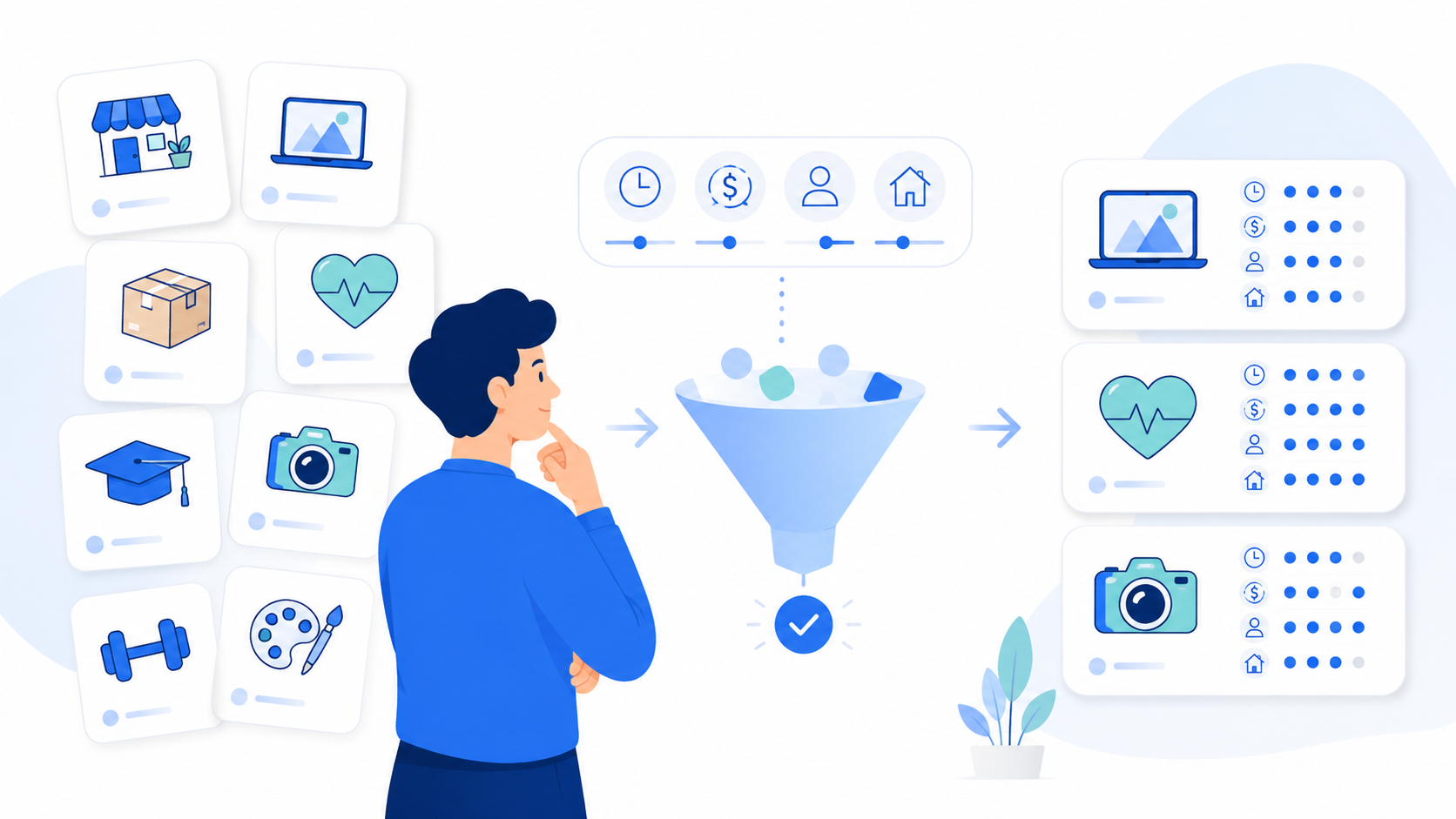
Most people do not get stuck because they have no ideas at all. They get stuck because they have too many half-ideas, doubts and unanswered questions.
You might be wondering:
- What could I actually offer?
- Would anyone pay for it?
- Do I have enough time?
- Do I need a big budget?
- What if I choose the wrong thing?
Choosing a business idea is not about finding the perfect idea straight away. It is about finding a realistic starting point you can test without turning your life upside down.
A good first business idea should fit your time, skills, budget, confidence and the type of customer you can realistically reach.
If you want a guided starting point, you can also take the Find Your Business Idea Quiz. It is designed to help you narrow your options and spot ideas that fit your real situation.
Start with your real life, not someone else’s business
It is easy to look at other people’s businesses and think you should copy what seems to be working for them.
But your starting point may be completely different.
Someone else may have more time, more money, more contacts, more confidence, a different location or years of experience in a certain field. That does not mean you cannot start. It means your first version needs to fit you.
Before choosing an idea, ask:
- How much time can I give this each week?
- Do I need something I can do around work, children or caring responsibilities?
- Do I want to work online, locally or both?
- Do I have money for equipment, stock, software or insurance?
- Do I need to earn quickly, or can I test slowly?
- Would I rather provide a service, sell products or create something digital?
A business idea that looks good on paper may not be a good fit if it needs time, money or energy you do not currently have.
The aim is not to pick the most impressive idea. The aim is to pick something you can actually begin.
Look at what you already know, do or notice
Your first business idea does not have to come from a dramatic new invention. Many starter businesses come from ordinary skills, useful experience or problems you already understand.
Look at three areas.
1. Skills you already use
These could be work skills, life skills or practical skills.
For example:
- admin
- writing
- cleaning
- organising
- bookkeeping
- design
- childcare experience
- cooking
- DIY
- tutoring
- customer service
- social media
- planning events
- fixing things
- helping people understand a process
You do not need to be the best in the country. You do need to be useful to a specific type of person.
2. Problems people ask you about
Think about what people already come to you for.
Do they ask you to explain forms, organise things, recommend products, proofread documents, make things look better, sort out tech problems or help them make decisions?
These small clues can point towards a business idea.
3. Things you understand better than most people
You may understand a certain group, industry, life stage or type of problem.
For example:
- parents trying to organise family life
- small businesses needing admin help
- local people who need reliable home services
- beginners learning a skill
- older people who need patient support with technology
- professionals who do not have time to manage small tasks
Good business ideas often come from understanding a real problem clearly.
Choose a problem before choosing a name
Many people start by thinking about the business name, logo, Instagram handle or website.
Those things can come later.
First, get clear on the problem your business could solve.
A simple way to write this is:
“I help [type of person] with [specific problem] so they can [useful outcome].”
For example:
- I help busy small business owners keep their admin organised so they can spend less time chasing paperwork.
- I help local families with garden maintenance so they can keep their outdoor space manageable.
- I help beginners learn basic bookkeeping so they feel more confident with their numbers.
- I help people create simple celebration cakes for small events without needing a large custom order.
This does not need to be perfect. It just needs to be clear enough to test.
If you cannot describe the problem, it may be too vague as a starting business idea.
Think about your first customer
A business idea becomes more realistic when you can picture who might buy from you.
Not “everyone”. Not “people who need help”. A more specific first customer.
Ask:
- Who has this problem?
- Where would they look for help?
- What would make them trust me?
- Would they pay for this, or only like the idea?
- Do they need it once, regularly or occasionally?
- Can I reach them without spending a lot on advertising?
For example, “social media help” is broad.
A clearer first customer might be:
- local tradespeople who want simple posts but do not want to manage everything themselves
- small beauty businesses that need help creating offers and appointment reminders
- new sole traders who need a basic profile and first few posts
The more clearly you can picture the customer, the easier it is to shape your offer, price and first message.
Check whether the idea fits your budget
Some business ideas need very little to start. Others need stock, tools, insurance, a licence, training, a website, packaging or a workspace.
This does not mean you should avoid every idea with costs. It means you should understand the costs before you commit.
Make a simple list:
- What do I already have?
- What would I need before taking a first customer?
- What can wait until later?
- What must be done properly from the start?
- Are there any legal, tax, safety, insurance or licence requirements?
For example, a freelance admin service may only need a laptop, internet, basic software and a clear service offer.
A food business may need more checks, hygiene requirements, packaging, equipment and local rules.
A product business may need money for samples, stock, postage, returns and storage.
This is a practical starting point, not legal or financial advice. Check the latest rules before you launch, especially if your idea involves food, children, health, finance, regulated advice, transport, treatments, construction or specialist services.
Avoid ideas that are too big for your first step
A common mistake is choosing an idea that sounds exciting but is too large to start.
For example:
- “I want to launch a full clothing brand.”
- “I want to build a marketplace.”
- “I want to open a café.”
- “I want to create an app.”
- “I want to start a coaching business for everyone.”
These may be possible later, but the first version may need to be smaller.
Ask:
“What is the smallest useful version I can test?”
That might mean:
- selling one product before building a full range
- offering one service before creating a full agency
- running a small workshop before launching a course
- taking a few local orders before renting premises
- creating a simple hosted business profile before building a full website
- testing interest with a clear message before spending money on branding
Starting small does not mean thinking small forever. It means reducing the risk while you learn.
Compare your ideas using simple criteria
If you have several ideas, do not just choose the one that sounds most exciting. Compare them properly.
Rate each idea from 1 to 5 for:
- Interest: Would I still care about this after the first few weeks?
- Skill fit: Can I do this well enough to charge for a starter version?
- Time fit: Can I run this around my current commitments?
- Budget fit: Can I afford the setup without putting myself under pressure?
- Customer clarity: Do I know who this is for?
- Demand: Are people already paying for something like this?
- Ease of testing: Can I test this without building everything first?
The best first idea is not always the most exciting. It is often the one with the clearest next step.
Do not wait until you feel completely confident
Confidence usually comes after action, not before it.
You may not feel ready to call yourself a business owner. You may worry that people will judge your idea. You may feel unsure about pricing, messages, setup and whether anyone will take you seriously.
That is normal.
The answer is not to rush. The answer is to choose a small, sensible test.
For example:
- write one clear starter offer
- ask five suitable people for feedback
- create a simple price list
- put together a basic checklist of what you need
- message one possible customer
- create a hosted profile so people can understand what you offer
- test one service before adding more
You do not need to have everything figured out. You do need a next step that gives you better information.
Watch out for business ideas that only work in theory
Some ideas sound good until you look at the practical details.
Be careful if an idea:
- depends on a large audience you do not yet have
- needs a lot of upfront money
- requires specialist permission you have not checked
- has unclear customers
- sounds impressive but is hard to explain
- relies on “going viral”
- only works if everything goes perfectly
- does not solve a problem people care enough to pay for
This does not mean the idea is impossible. It means you may need to simplify it, research it properly or choose an easier first test.
Use the quiz to narrow your options
Choosing a business idea can feel scattered when every option is still open.
The Find Your Business Idea Quiz helps you think through your situation more clearly. It looks at practical things like your time, confidence, skills, preferred way of working and the kind of business that may suit your starting point.
There are no right answers. The goal is not to label you. The goal is to help you find a business idea that fits your real life.
Once you have a clearer direction, you can move on to a launchpad, checklist or starter offer instead of staying stuck in research mode.
Take the quiz: Find Your Business Idea
A simple way to choose your first business idea
Use this process:
- Write down 5 to 10 possible ideas.
- Remove any that need money, time or approval you do not realistically have yet.
- Choose 2 or 3 that match your skills and situation.
- Describe the customer and problem for each one.
- Pick the idea with the clearest small test.
- Create a starter version.
- Get feedback before spending too much on setup.
The aim is not to prove that this is the only business you will ever run. The aim is to choose a practical starting point and learn from the next step.
Final thought
You do not need the perfect business idea to begin. You need a business idea you can understand, explain and test.
Start with your real life. Look at your skills, time, budget and first possible customer. Choose something small enough to try, but useful enough that someone might pay for it.
That is a better starting point than waiting for complete certainty.
Next step: Take the Find Your Business Idea Quiz and get a clearer direction for what to explore first.
FAQs
How do I know if a business idea is good?
A good business idea solves a real problem for a clear type of customer. It should also fit your time, budget, skills and confidence. You do not need to know everything at the start, but you should be able to explain who it helps and why they might pay for it.
What if I have too many business ideas?
Write them down and compare them using practical criteria: time, budget, skills, customer clarity, demand and ease of testing. The best first idea is usually the one you can test simply, not the one that sounds most impressive.
Should I choose a business idea based on passion?
Interest matters, but passion is not enough on its own. A business also needs customers, a clear offer and a practical way to make money. Look for an idea that combines interest with usefulness and demand.
Can I start a business with little money?
Some businesses can be tested with a small budget, especially service-based ideas. Others need money for stock, equipment, insurance, licences or specialist setup. Start by working out the smallest version you can test safely and properly.
What if I choose the wrong idea?
Choosing an idea is not a lifetime commitment. Your first idea is a starting point. Testing it with a small offer, simple message or first customer conversation can help you learn before you spend too much time or money.