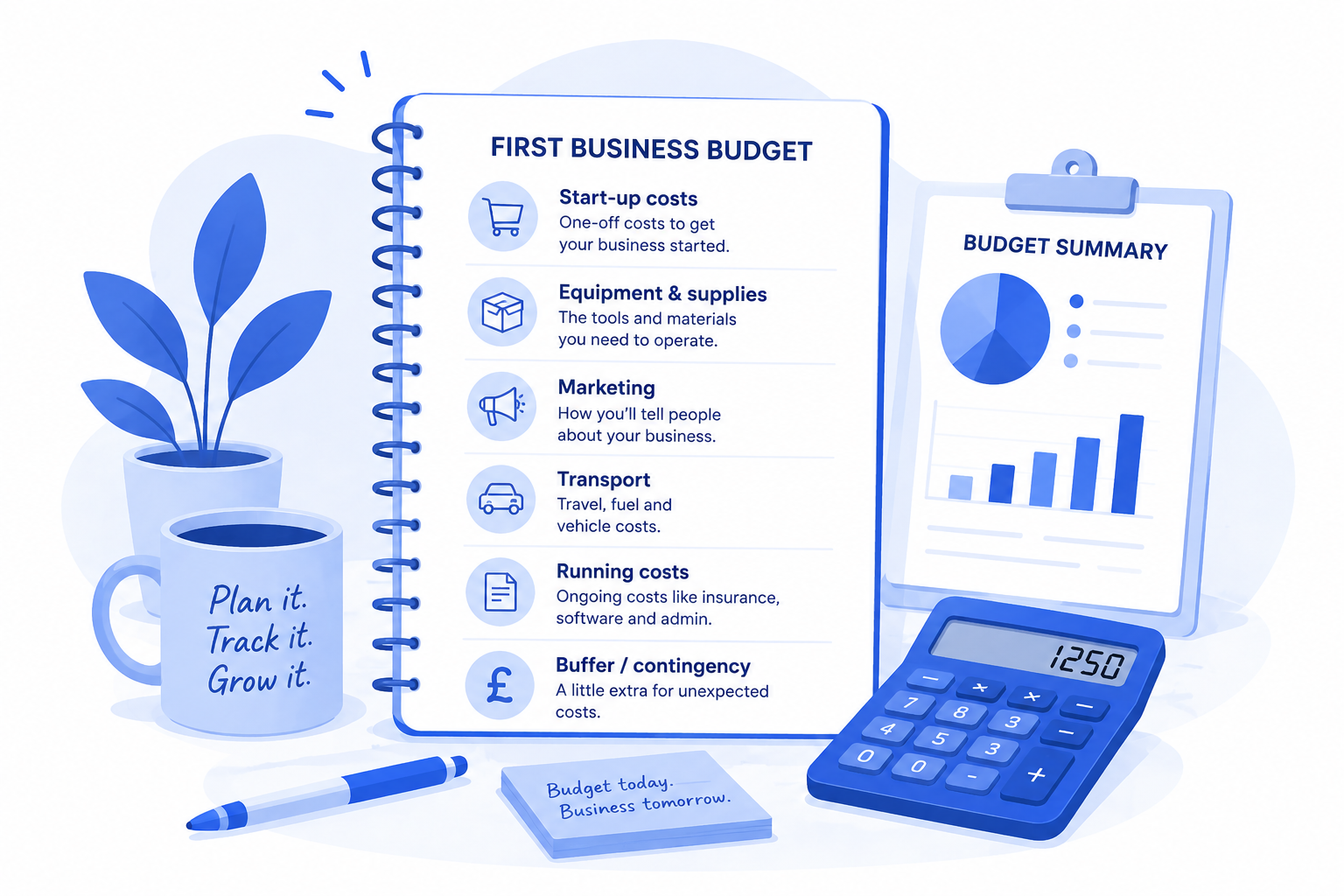
A first business budget does not need to be perfect. It does need to stop your money plans from living in your head.
When you are starting a small business, it is easy to guess the numbers. You might roughly know what equipment you need, what you want to charge, or how much you can afford to spend. But rough guesses can quickly become stressful once payments, bills, stock, software and tax all start to overlap.
Your first budget should give you a clear view of what the business needs, what it might earn, and what could go wrong.
It will not guarantee that the business works. But it can help you avoid spending too much too soon, undercharging, or being surprised by basic costs.
This is a practical starting point, not financial, tax or legal advice. Check the latest rules before you launch, and speak to an accountant or relevant professional if anything is specific to your situation.
What this helps with
A first business budget helps you answer simple but important questions:
- How much money do I need to start?
- What will I need to pay for every month?
- How much should I charge?
- How many sales, bookings or clients do I need?
- What should I set aside for tax and future costs?
- Can I test this idea without overspending?
- What costs can wait until later?
The aim is not to create a complicated spreadsheet. The aim is to understand the money side before you make big decisions.
Why your first budget matters
Many new business owners do not struggle because they are bad with money. They struggle because the real costs were not clear at the beginning.
A logo here, a tool there, a bit of stock, a few adverts, a subscription, some packaging, a training course — none of these may seem huge on their own. Together, they can add up quickly.
A budget helps you slow down and ask:
“Do I need this now, or can it wait until the idea has been tested?”
That one question can save a lot of wasted money.
1. Startup costs
Startup costs are the things you need before you can properly begin.
This might include:
- basic tools or equipment
- initial stock or materials
- website or domain costs
- insurance
- licences, registrations or checks
- branding or design
- packaging
- training or qualifications
- professional advice
- software setup
- payment system setup
- initial marketing materials
Keep this list realistic. Your first budget should not include every nice-to-have item.
A useful question is:
“What do I need to serve my first customer safely, clearly and properly?”
For some businesses, the answer may be quite small. For others, especially food, beauty, childcare, fitness, trades, transport or regulated services, there may be important checks, insurance or approvals before you start.
2. Monthly running costs
Running costs are the regular costs your business needs to keep going.
These may include:
- software subscriptions
- phone or internet costs
- workspace, studio or storage
- insurance
- accountancy or bookkeeping
- website hosting
- marketing or advertising
- travel
- bank or payment fees
- stock replacement
- materials
- postage
- packaging
- professional memberships
- vehicle costs where relevant
Some costs happen every month. Others may happen quarterly or yearly, but it still helps to break them down into a monthly amount.
For example, if something costs £120 per year, think of it as £10 per month. That gives you a clearer picture of what the business really needs to cover.
3. One-off costs
Not every cost repeats each month.
Your first budget should also include one-off costs, such as:
- a piece of equipment
- a training course
- a product sample order
- signage
- a photoshoot
- legal documents
- setup help
- repairs or upgrades
- launch materials
One-off costs can be useful, but they can also make your early budget look better or worse than it really is.
Keep them separate from your normal monthly costs so you can see the difference between setting up the business and running it.
4. Product or service delivery costs
These are the costs involved each time you sell something.
For a product business, this might include:
- stock
- materials
- packaging
- postage
- platform fees
- payment processing fees
- damaged items
- returns
- storage
For a service business, this might include:
- travel
- materials used during the service
- preparation time
- follow-up time
- printed resources
- booking software
- assistant or contractor costs
- payment fees
This section matters because it affects your pricing.
If you charge £50 for a service but spend £15 on materials, £5 on travel and two hours delivering it, you need to understand what is really left.
5. Your own time
Many first-time business owners forget to budget for their own time.
This is especially common when starting as a sole trader, freelancer, maker, consultant, coach or local service provider.
Your time includes more than the main appointment or delivery.
It may include:
- replying to messages
- quoting
- planning
- buying materials
- travelling
- packing orders
- cleaning equipment
- sending invoices
- updating records
- following up with customers
- creating content
- dealing with problems
You may not pay yourself properly at the very beginning, but you still need to know whether the business can eventually pay for your time.
A busy business is not automatically a healthy business.
6. Pricing assumptions
Your budget should include what you plan to charge.
You do not need perfect pricing from day one, but you do need a starting point based on real costs.
Write down:
- your price per product, session, package or service
- what it costs you to deliver each sale
- how much time each sale takes
- what is left after direct costs
- whether the price feels realistic for the customer
- whether the price feels worthwhile for you
Avoid choosing a price only because it feels safe.
Low prices can help you get started, but if they do not cover your costs, they can make the business harder to sustain.
7. Sales or booking targets
Your budget should show how many sales, bookings or clients you need.
This does not need to be a huge forecast. Start with a simple question:
“How many do I need to sell each month to cover my basic costs?”
For example:
If your monthly business costs are £300 and you make £30 after direct costs from each sale, you need 10 sales just to cover those business costs.
That does not yet include your personal income. It simply shows the basic pressure on the business.
This helps you see whether the idea is realistic. If you need 200 sales a month but have no clear way to reach customers, the plan may need adjusting.
8. Tax and National Insurance
Your first budget should include money set aside for tax and any relevant contributions.
The amount will depend on your business structure, income, expenses and personal situation.
Do not wait until tax is due before thinking about it. A simple habit is to set aside a percentage of each payment into a separate pot, then get proper advice if you are unsure how much you may need.
Depending on your business, you may also need to understand VAT, payroll, corporation tax, allowable expenses or other rules.
This is an area where it is worth checking the latest guidance and speaking to an accountant if anything is unclear.
9. Insurance, licences and professional checks
Some businesses need more than a good idea and a way to take payment.
Depending on what you do, you may need:
- public liability insurance
- professional indemnity insurance
- product liability insurance
- employer’s liability insurance if you employ people
- licences or permits
- DBS checks
- food hygiene requirements
- health and safety checks
- professional qualifications
- sector-specific approval
Do not leave these out of your budget.
They may not feel exciting, but they can be essential before you start taking customers.
10. Marketing and customer finding costs
Your budget should include how you plan to find customers.
This does not always mean paid advertising. It might mean simple, low-cost activity first.
Possible costs include:
- flyers or printed materials
- local directory listings
- social media tools
- website costs
- photography
- email software
- marketplace fees
- sample products
- event stalls
- networking fees
- introductory offers
Be careful with marketing spend before you know your offer is clear.
It is usually better to test a simple message with a small audience than to spend heavily trying to promote an unclear offer.
11. Admin and bookkeeping costs
Admin is easy to ignore until it piles up.
Your budget may need to include:
- accounting software
- invoicing tools
- bookkeeping support
- accountant fees
- business bank account fees
- document storage
- contract templates
- payment processing charges
Even if you start with a simple spreadsheet, allow time and possibly money for keeping records properly.
Good records make it easier to understand whether the business is actually working.
12. A small safety buffer
Your first budget should include a buffer where possible.
Things rarely go exactly to plan. Customers may pay late. Equipment may break. Stock may cost more than expected. A quiet month may come sooner than you hoped.
A buffer gives you breathing room.
It might cover:
- unexpected bills
- refunds
- replacement materials
- late payments
- quiet weeks
- small mistakes
- emergency repairs
You do not need a huge reserve before testing a small idea. But it is sensible not to spend every pound as soon as it comes in.
13. Personal money needs
If you are relying on the business to pay you, your personal money needs matter too.
Think about:
- how much you need to take from the business
- how soon you need that income
- whether you have savings or another income source
- what happens if sales are slow
- whether you can test the idea alongside employment or other work
This is not about putting pressure on yourself. It is about being honest.
A business that only needs to earn a small side income can be built differently from one that needs to replace a full-time wage quickly.
14. Costs that can wait
A good first budget should also show what you are not buying yet.
This might include:
- advanced software
- expensive branding
- large stock orders
- office space
- paid ads
- high-end equipment
- a full website
- branded uniforms
- professional photography
- extra product ranges
Some of these may be useful later. They may not be needed before your first enquiry, booking or sale.
Label them as “later” costs rather than deleting them completely. That way you are not ignoring them, but you are not letting them delay or drain the early stage.
A simple first business budget structure
You can start with a basic budget like this:
| Budget area | What to include |
|---|---|
| Startup costs | Equipment, setup, stock, insurance, licences, website |
| Monthly costs | Software, marketing, travel, storage, subscriptions |
| Delivery costs | Materials, packaging, postage, payment fees, travel |
| Pricing | What you charge and what is left after direct costs |
| Sales target | How many sales or bookings you need each month |
| Tax pot | Money set aside from each payment |
| Safety buffer | Money kept back for problems or quiet periods |
| Later costs | Things you want but do not need yet |
This is enough to give you a clearer starting point.
You can make it more detailed as the business grows.
Practical next step
Before you spend more money, make a one-page budget.
Write down:
- the minimum you need to start
- your regular monthly costs
- your cost per sale or booking
- your starting price
- how many sales you need to cover costs
- what you will set aside
- what you will not buy yet
Then look at the numbers and ask:
“Is this a realistic first version of the business?”
If the answer is no, reduce the idea before you abandon it. You may not need a different business. You may need a smaller, cheaper, easier-to-test version.