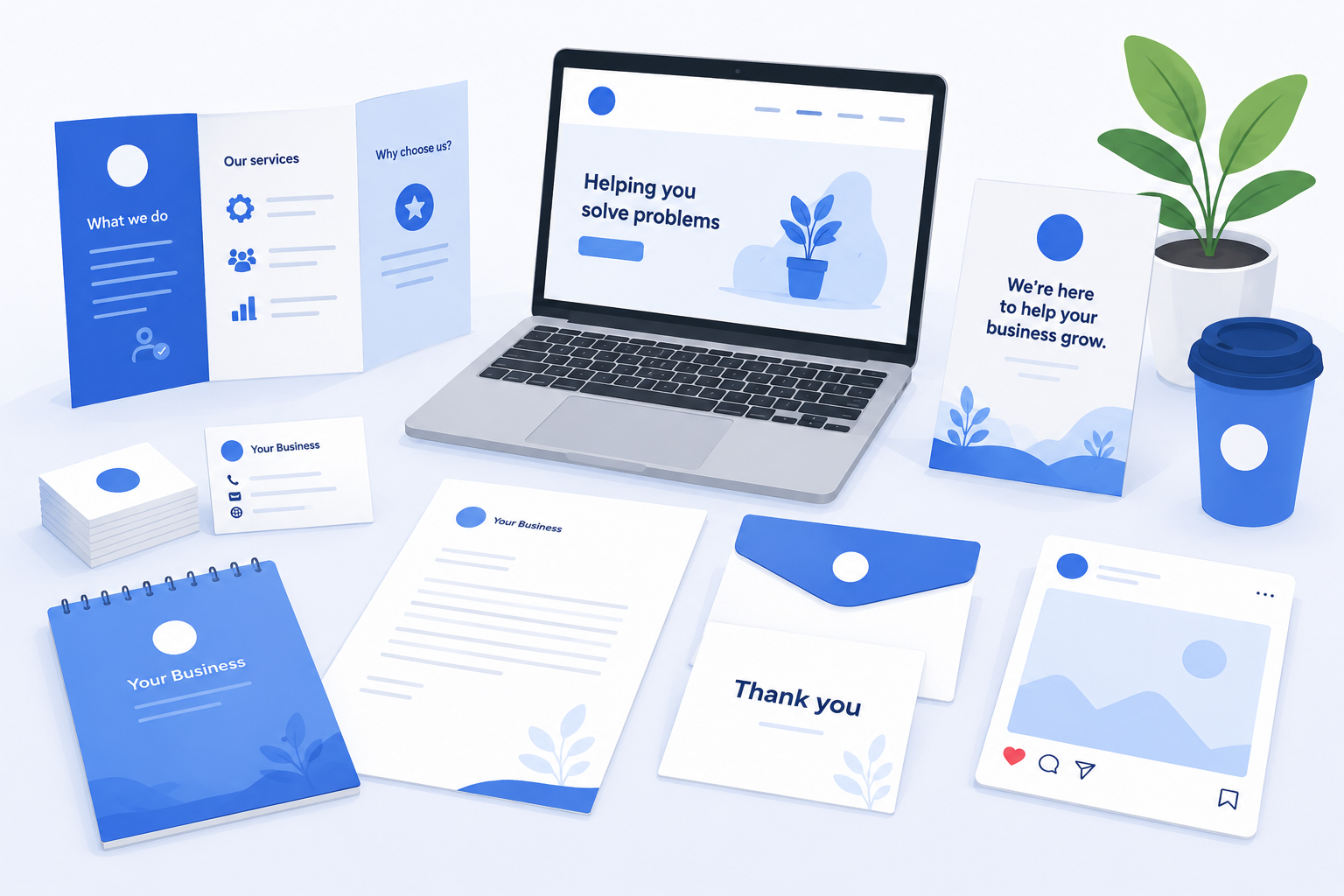
A new business does not need every marketing material straight away.
It is easy to feel as if you need a logo, website, flyers, social media templates, business cards, photos, brochures, adverts, email list, booking page and printed packaging before you can start.
Some of those things may be useful later. But at the beginning, your marketing materials have one simple job:
Help the right person understand what you offer, why it matters, and what to do next.
You do not need to look like a large company. You need to look clear, trustworthy and ready enough to handle a first enquiry.
What this helps with
This guide is for anyone starting a first business, side business, microbusiness or small service who is unsure what marketing materials to create first.
It will help you decide:
- what you actually need before promoting your business
- what can wait until later
- how to avoid spending too much too early
- what information every material should include
- how to make your business easier to understand
- what to prepare before your first customer enquiry
The aim is not to build a full marketing system on day one. The aim is to create the basics that help people take you seriously and contact you.
Why marketing materials matter
Marketing materials are not just decoration.
They help people answer simple questions:
- What do you do?
- Who is it for?
- How much does it cost?
- Where are you based or how do you deliver?
- How does it work?
- Can I trust you?
- What should I do next?
If people cannot answer those questions quickly, they may move on, even if your offer is useful.
Good marketing materials do not need to be expensive. They need to reduce confusion.
Start with the message before the design
Before you create anything visual, get the wording clear.
A polished flyer or website will not help much if people still cannot understand what you offer.
Start with this simple sentence:
I help [type of customer] with [problem or need] by offering [product or service].
For example:
- I help small business owners keep on top of admin by offering weekly virtual assistant support.
- I help local dog owners who work long hours by offering weekday dog walking in [area].
- I help parents support their children’s learning by offering GCSE maths tutoring online.
- I help people buying gifts by offering handmade candles in small seasonal batches.
- I help sole traders look more professional by creating simple one-page websites.
Once this sentence is clear, your marketing materials become much easier to create.
The basic marketing materials most new businesses need
You do not need all of these in a polished form straight away, but these are the core pieces worth preparing.
1. A clear business description
Your business description is a short explanation of what you do.
You will use it on your social media profile, website, flyers, directories, emails, messages and introductions.
A simple version could include:
- what you offer
- who it is for
- where you work or how you deliver
- the main problem it helps with
- the next step
Example:
I offer bookkeeping support for sole traders and small business owners who want their records kept organised without dealing with everything themselves. I work remotely across the UK. Message me to ask about monthly support packages.
This does not need to be clever. It needs to be easy to understand.
2. A simple offer or price list
People need to know what they can actually buy.
Your offer or price list might include:
- service packages
- product options
- starting prices
- what is included
- what is not included
- delivery, travel or collection details
- booking or order instructions
- payment terms
You do not always need to publish every price publicly, especially if your work is quoted individually. But you should have a clear way to explain pricing when someone asks.
Avoid making every enquiry depend on a long back-and-forth conversation. People are more likely to act when the offer is easy to understand.
3. A way for people to contact or book
Every piece of marketing should make the next step obvious.
Depending on your business, this might be:
- a phone number
- email address
- contact form
- booking link
- enquiry form
- direct message instruction
- order page
- hosted business profile
Make sure this is visible and simple.
Avoid sending people through too many steps before they can ask a question or book.
A good call to action might be:
- Message me for the price list
- Book a free enquiry call
- Ask for a quote
- View available slots
- Order through the profile
- Send your measurements
- Check delivery options
The best CTA is the one that tells people exactly what happens next.
4. A basic social media profile
You do not need to be on every platform.
Choose the place your likely customers are most likely to use, and make the profile clear.
Your profile should include:
- business name
- what you offer
- who it is for
- location or delivery area
- contact method
- link to your profile, booking page or website
- a few useful posts explaining the offer
A new visitor should not have to scroll for five minutes to work out what you do.
Your pinned post or first few posts can explain:
- what you offer
- how it works
- who it helps
- prices or starting prices
- how to enquire
- common questions
A clear profile is often more useful than a busy one.
5. A hosted business profile or simple web page
A full website is not always necessary at the very beginning.
But it is useful to have one clear place where people can see your key details.
This could be a hosted business profile, simple landing page or basic website.
It should include:
- what you offer
- who it is for
- location or delivery area
- prices or how quotes work
- examples, where relevant
- contact details
- booking or enquiry instructions
- trust signals, such as experience, qualifications or reviews
This gives you somewhere to send people after they see your social media post, flyer, advert or recommendation.
It also helps you look more organised.
6. A first customer message
One of the most useful marketing materials is not a public post at all.
It is a simple message you can send when someone asks about your business.
For example:
Thanks for your message. I offer [service/product] for [type of customer]. The best option for what you’ve described is [option]. It includes [key details] and costs [price]. If you’d like to go ahead, the next step is [booking/payment/confirmation].
This saves you from rewriting everything each time.
You can create versions for:
- first enquiries
- quote requests
- booking confirmations
- price explanations
- follow-ups
- thank-you messages
- review requests
Clear messages can make a small business feel much more professional.
7. Basic images or examples
People often want to see what they are buying, especially for visual, practical or trust-based businesses.
Depending on your business, this might include:
- product photos
- before-and-after images
- portfolio examples
- screenshots
- samples
- service process photos
- workspace images
- packaging images
- examples of previous work
You do not always need expensive photography at the start. Clear, well-lit, honest images are usually enough for a simple first version.
For service businesses, you can also show:
- the steps in your process
- what is included in a package
- the type of problem you solve
- a simple checklist or result
If you do not have customer work to show yet, create sample examples where appropriate. Be clear that they are samples, not client results.
8. A simple flyer or printable one-page sheet
Printed materials are useful for some businesses, but not all.
A flyer may help if you are offering:
- local services
- events
- classes
- food services
- home services
- pet services
- tutoring
- beauty or wellbeing services
- community-based support
- trades or maintenance
A basic flyer should include:
- business name
- clear headline
- what you offer
- who it is for
- area covered
- key benefits or services
- price or starting price, where useful
- contact details
- website, profile or QR code
- simple CTA
Do not overcrowd it. A flyer should help someone decide whether to contact you, not explain every detail.
9. A short introduction for referrals
Many first customers come through people you already know.
Make it easy for others to describe your business.
Write a short referral introduction they can copy and send.
For example:
My friend has started offering social media support for small business owners who need help writing regular posts. She is starting with simple monthly packages and is taking on a few new clients. I can send you her details if helpful.
This is useful because people often want to recommend you but do not know exactly what to say.
Give them the wording.
10. Proof or trust signals
When your business is new, people may need reassurance.
Trust signals might include:
- relevant experience
- qualifications
- insurance, where relevant
- licences or checks, where relevant
- testimonials
- reviews
- examples of work
- before-and-after photos
- clear terms
- professional memberships
- secure payment options
- response times
- refund or cancellation information
You do not need to pretend you have years of business history if you do not.
Use what is true.
For example:
New business, but 8 years’ experience in customer service and admin.
Or:
Currently taking on first local clients while building reviews.
Honesty is better than overpolishing.
What can usually wait until later?
Some marketing materials may be useful, but they are not always needed before you test the business.
These can often wait:
- a full brand identity
- expensive logo package
- advanced website
- professional photoshoot
- printed brochures
- paid adverts
- branded uniforms
- large banner stands
- complex email funnels
- full content strategy
- video production
- merchandise
- large packaging orders
There is nothing wrong with investing in these later. The risk is spending too much before you know whether people want the offer.
Start with the materials that help you get a first enquiry, booking or sale.
What every marketing material should include
Whether it is a flyer, post, profile, message or website, check that it answers the basics:
- What is this?
- Who is it for?
- What problem does it help with?
- What is included?
- Where is it available?
- How much does it cost, or how do people get a quote?
- Why should someone trust you?
- What should they do next?
If one of these is missing, people may hesitate.
Marketing is not only about being seen. It is about being understood.
Do not hide behind marketing materials
It is easy to keep creating materials instead of speaking to real people.
You may feel productive making templates, adjusting colours, editing your logo or rewriting your bio. Some of that can help, but it can also become a way to delay getting feedback.
A useful question is:
“Will this help someone enquire, book or buy?”
If the answer is no, it may not be the next priority.
At the beginning, customer conversations are often more useful than perfect branding.
Be careful with claims
Some businesses need extra care with what they say in their marketing.
This may apply if you work in areas such as health, beauty, finance, legal services, food, childcare, education, fitness, supplements, property or regulated industries.
Avoid making claims you cannot support.
Check the latest rules before you promote your business, and get professional advice where needed.
This is a practical starting point, not legal, financial or regulated professional advice.
A simple starter marketing kit
For many new businesses, a simple starter kit could include:
| Marketing material | Purpose |
|---|---|
| Business description | Explains what you do clearly |
| Offer or price list | Shows what people can buy |
| Social media profile | Helps people discover and understand you |
| Hosted profile or simple page | Gives people one clear place for details |
| Enquiry message template | Helps you reply quickly and professionally |
| Basic images or examples | Shows what people can expect |
| Simple CTA | Tells people what to do next |
| Referral introduction | Helps others recommend you |
That is enough for many first tests.
You can add more once you know what works.
Practical next step
Before creating anything new, check what you already have.
Write down:
- your business description
- your main offer
- your starting price or quote process
- your contact method
- your next step for interested people
- three common questions customers may ask
- one short message you can send to enquiries
Then choose the one missing material that would make it easier for someone to contact you.
Not the fanciest one.
The most useful one.