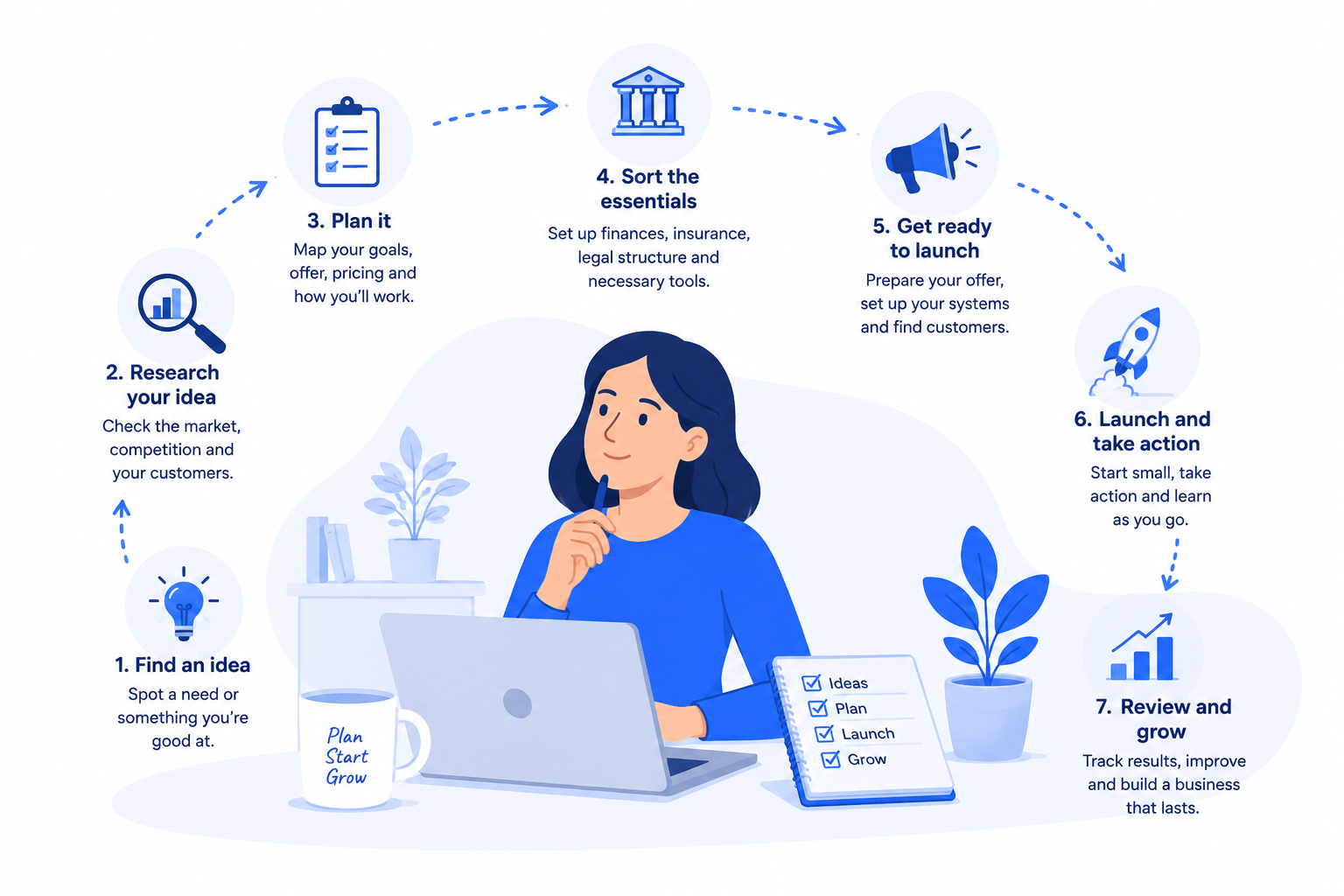
Most people hear “start a business” and picture something bigger than it needs to be.
They imagine a full brand, a website, a logo, a business plan, a big launch, legal forms, social media, stock, software, tax, insurance and a long list of things they do not fully understand yet.
That can make starting feel too heavy before anything has even happened.
In reality, starting a business usually means something much simpler:
You choose something useful to offer, work out who it is for, check whether people may pay for it, set it up properly enough to begin, and take the first small steps towards customers.
It does not all happen at once. It does not need to be perfect on day one.
What this helps with
This guide is for anyone thinking about a first business, side business, microbusiness or small service but feeling unsure what “starting” actually means.
It will help you understand:
- what needs to happen before you launch
- what can usually wait until later
- how to think about money, setup and customers
- why starting small is often more useful than planning everything
- what your next practical step could be
The aim is not to make starting a business sound easy. The aim is to make it feel clearer.
Starting a business begins with an offer
A business is not just an idea. It needs an offer.
An offer is what someone can actually buy from you.
For example:
- a cleaning service for local homes
- a bookkeeping package for sole traders
- handmade candles sold online
- tutoring for GCSE maths
- social media support for small businesses
- mobile beauty treatments
- dog walking in a specific area
- a meal prep service
- admin support for busy consultants
The offer does not need to be perfect at the beginning. But it does need to be clear enough for someone to understand.
A useful starting question is:
“What can I offer, who is it for, and what problem does it help with?”
If you cannot answer that yet, you may not need a logo or website. You may need to shape the offer first.
You need to know who the business is for
Many new business ideas stay vague because the customer is vague.
Saying “this is for everyone” usually makes it harder to decide what to offer, what to charge and where to find customers.
You do not need a complicated customer profile. You just need a practical picture of who you are trying to help.
For example:
- parents who need after-school tutoring
- small business owners who hate doing admin
- people planning low-budget weddings
- local dog owners who work long shifts
- makers who need help setting up an online shop
- landlords who need reliable property maintenance
When you know who the business is for, your decisions become easier.
You can ask:
- What do they need?
- What are they already paying for?
- What would make this easier for them?
- Where would they look for help?
- What would make them trust me?
That is more useful than trying to appeal to everyone.
You need to test whether people want it
Starting a business does not mean spending months building something in private and hoping people buy it later.
A better early step is to test demand.
This could mean:
- speaking to potential customers
- asking what they currently use or pay for
- sharing a simple description of your offer
- testing a small batch of products
- offering a limited number of starter bookings
- creating a simple price list
- seeing whether people ask questions, book, enquire or buy
You are looking for useful signals.
People saying “that sounds nice” is not the same as demand. A stronger signal is someone asking about price, availability, delivery, timing or how to book.
The first version of your business is not there to prove you are brilliant. It is there to help you learn what people actually respond to.
You need to understand the basic numbers
Money does not need to be complicated at the start, but it cannot be ignored.
You need to know:
- what it costs to start
- what it costs to deliver each product or service
- what you will charge
- how much time each sale takes
- what money needs to be set aside
- how many sales, bookings or clients you need
- whether the idea is realistic for your current life
Sales are not the same as profit. If someone pays you £100, you may still need to cover materials, travel, software, payment fees, packaging, tax, insurance and your own time.
A simple first budget can stop you from undercharging or spending too much before the idea has been tested.
This is a practical starting point, not financial or tax advice. Check the latest rules before you launch, and speak to an accountant if anything is specific to your situation.
You may need legal, tax, insurance or sector checks
Some business types are simple to test. Others need checks before you offer anything.
Depending on what you do, you may need to think about:
- business structure
- tax registration
- insurance
- licences or permits
- contracts or terms
- data protection
- food hygiene
- health and safety
- DBS checks
- qualifications
- professional or industry rules
This can feel off-putting, but it is better to know early.
A home baking business, tutoring service, beauty treatment, childcare service, food stall, fitness business, trade business or product business may all have different requirements.
You do not need to become an expert in every rule. You do need to check what applies to your type of business before you start taking customers.
For anything specific to your situation, speak to an accountant, solicitor, insurer or relevant professional.
You need a simple way to be found
Customers need a way to understand what you do and contact you.
That does not always mean building a full website straight away.
Depending on the business, your first version might be:
- a hosted business profile
- a simple landing page
- a clear social media profile
- a local directory listing
- a marketplace profile
- a PDF price list
- a booking page
- a basic portfolio
- a flyer with contact details
The key is clarity.
A potential customer should be able to see:
- what you offer
- who it is for
- where you work or how you deliver
- what it costs, or how to ask for a quote
- how to contact or book
- why they should trust you
A simple clear profile is usually better than a polished page that does not explain the offer.
You need to find your first customer or enquiry
A business does not really start moving until you speak to real people.
This is where many people get stuck. They spend time preparing the business but avoid putting the offer in front of anyone.
Finding your first customer may involve:
- messaging people who may need the service
- asking for introductions
- posting a clear offer
- joining relevant local or online groups
- contacting small businesses directly
- offering a limited starter package
- asking past colleagues or contacts
- attending local events
- listing on a suitable platform
- following up with warm enquiries
The aim is not to become famous. The aim is to get your first useful conversation, enquiry, booking or sale.
That gives you more information than weeks of private planning.
You need basic systems, not complicated ones
Once someone is interested, you need a way to manage the work properly.
At the beginning, this can be simple.
You may need:
- a way to record enquiries
- a quote or price list
- an invoice template
- a payment method
- a booking process
- a customer message template
- a receipt or order record
- a simple spreadsheet for income and expenses
- a place to store customer details safely
- a checklist for delivering the service or order
You do not need every tool available. Too much software too early can make things messier.
Start with the systems that help you avoid mistakes, keep records and serve customers properly.
You need to make decisions in the right order
A lot of people overthink starting a business because they try to answer every question at once.
They ask:
- What should the business be called?
- Should I be a sole trader or limited company?
- Do I need a website?
- What should I post on social media?
- How much should I charge?
- What if nobody buys?
- What if too many people buy?
- What if I choose the wrong idea?
These are fair questions, but they do not all need answering at the same time.
A more useful order is:
- What am I offering?
- Who is it for?
- Is there a small version I can test?
- What will it cost to start safely?
- What rules or checks apply?
- How will people find out about it?
- How will they enquire, book or buy?
- What do I need to track once money comes in?
That keeps the process structured, not scattered.
What can usually wait until later?
Not everything needs to be done before you begin testing.
Depending on the business, these may be able to wait:
- a full brand identity
- expensive photography
- advanced software
- a large website
- paid adverts
- bulk stock orders
- office space
- branded clothing
- a full content strategy
- complex automation
- a long business plan
Some of these may become useful later. But they are not always needed before your first enquiry or sale.
The early stage is about learning what works before you spend too heavily.
What does “launched” actually mean?
A launch does not have to be dramatic.
For a small business, launching might simply mean:
- your offer is clear
- your basic checks are done
- your price is ready
- people know how to contact you
- you have a way to take payment
- you are ready to handle your first enquiry, booking or order
That is enough to begin.
You can improve the business as you learn. Your first version is allowed to be simple.
Practical next step
Write down your business idea in this format:
I help [type of customer] with [problem or need] by offering [product or service].
Then add:
- the smallest version you could test
- what you would charge
- what it would cost to deliver
- what checks you need before starting
- how a customer would find you
- how they would enquire or buy
- what you need to set up first
This gives you a clearer picture of what starting actually involves for your idea.