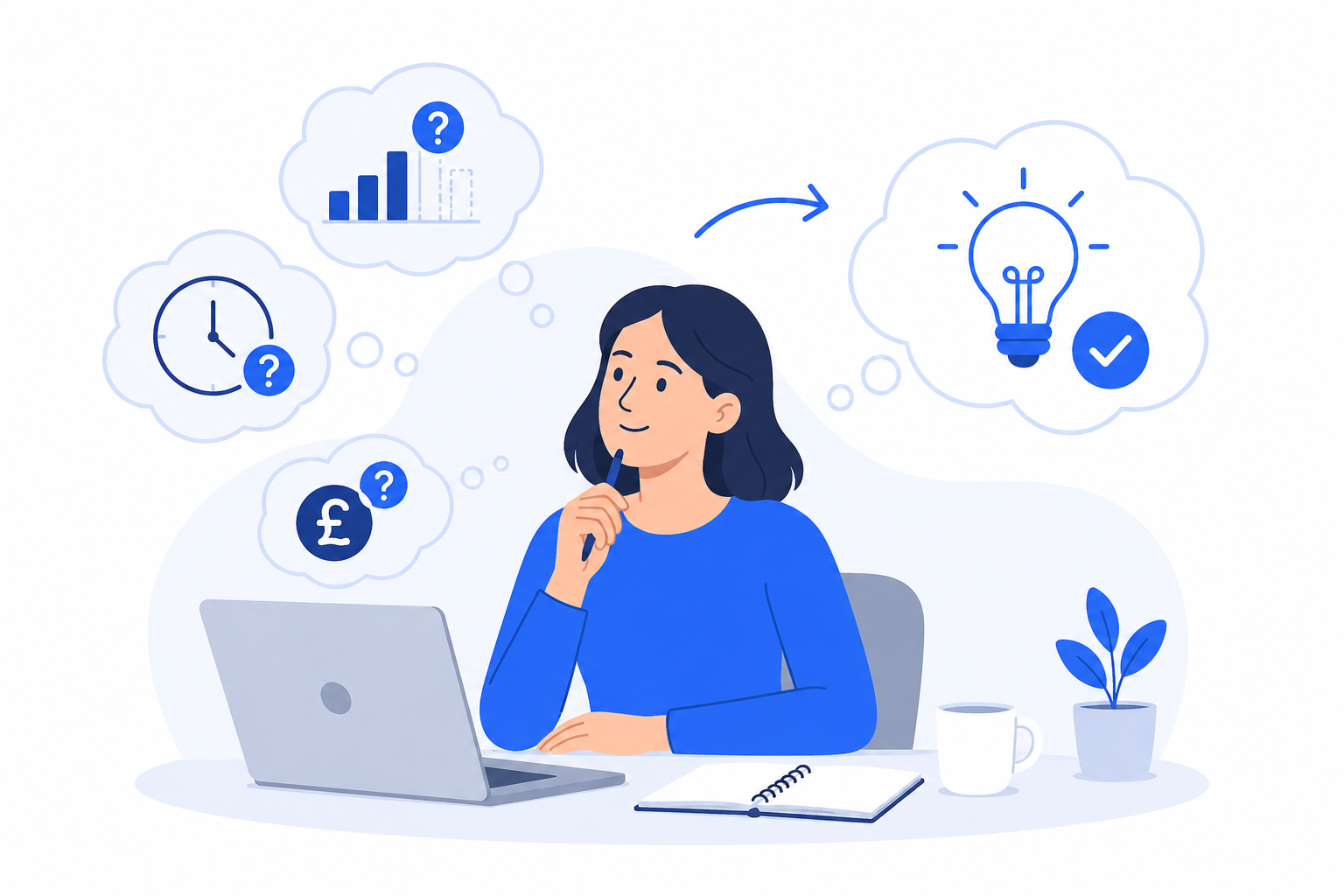
Most people do not get stuck because they have no ideas. They get stuck because every idea turns into a long list of doubts.
What if it does not work?
What if someone else is already doing it?
What if I choose the wrong thing?
What if I spend money and regret it?
Those are normal questions. Starting a business involves time, effort, confidence and usually some cost. It makes sense to think carefully.
The problem starts when thinking becomes a way to avoid choosing a next step.
You do not need the perfect business idea before you start. You need a small, realistic version you can test.
Why first business ideas feel so difficult
Your first business idea can feel bigger than it really is.
Instead of seeing it as a simple starting point, it can start to feel like a permanent decision about your future. That pressure makes every option feel risky.
You may find yourself comparing ideas, reading blogs, watching videos, changing your mind, and waiting until one idea feels completely safe.
But no business idea feels completely safe at the beginning.
A better question is not:
“Is this the perfect idea?”
A better question is:
“Is this a sensible idea to test with my current time, budget and skills?”
That keeps the decision grounded.
Start with your real life, not a fantasy version of it
A business idea has to fit the life you actually have.
That includes your available time, money, energy, skills, confidence and responsibilities.
For example, if you work full-time, care for family, or have a tight budget, your first business may need to be small and flexible. That does not make it less valid. It just makes it more realistic.
Before judging an idea, ask:
- Could I test this in evenings or weekends?
- Would it need expensive equipment before I know if anyone wants it?
- Do I already have some of the skills needed?
- Could I explain the offer clearly to a potential customer?
- Is there a simple first version?
If the answer is mostly no, the idea may not be wrong. It may just be too big for your current starting point.
Do not try to build the whole business in your head
Overthinking often happens when you try to solve everything at once.
You start with a simple idea, then suddenly you are thinking about branding, websites, pricing, insurance, tax, packaging, social media, customer service, business names, logos and whether you need a five-year plan.
That is too much at the idea stage.
Your first job is not to build the finished business. Your first job is to work out whether there is a small offer worth testing.
For example:
- A cleaning business could start with one clear service and one local area.
- A tutoring business could start with one subject and one age group.
- A handmade product business could start with a small batch.
- A consulting business could start with one useful service for one type of client.
- A food business could start by checking rules, costs and demand before buying equipment.
The aim is to reduce the idea until it becomes testable.
Use a simple idea filter
When you have too many ideas, use a practical filter instead of relying on feelings.
For each idea, ask:
- Who would pay for this?
Be specific. “Busy parents”, “local tradespeople”, “small ecommerce shops” or “new dog owners” is more useful than “everyone”. - What problem does it solve?
A business does not have to solve a huge problem. It can save time, reduce stress, improve a result, provide convenience or make something easier. - Can I start small?
Look for an affordable first version. Avoid ideas that need heavy spending before you can test demand. - Can I reach the first few people?
If you have no clear way to find potential customers, the idea may need more thought. - Would I be willing to do the work repeatedly?
Interest matters, but so does the day-to-day reality. Some ideas sound good until you picture the actual tasks.
This kind of filter helps you move from “Which idea sounds best?” to “Which idea is easiest to test properly?”
Stop asking everyone for opinions
Feedback can help, but too many opinions can make the decision harder.
Friends and family may mean well, but they may not understand your budget, your market, or what your customer actually needs. Some people will be too negative. Others will be too encouraging. Neither is the same as real demand.
Instead of asking, “Do you think this is a good idea?”, try asking more useful questions:
- “Would you pay for this?”
- “What would make this useful?”
- “Where would you normally look for this?”
- “What would put you off?”
- “What would you expect to pay?”
Even better, speak to people who are close to the type of customer you want to serve.
You are not looking for applause. You are looking for useful signals.
Give yourself a decision deadline
Overthinking grows when there is no deadline.
You can keep researching forever if you let yourself. At some point, you need to choose a small next step and learn from it.
A simple approach is to give yourself a short decision window.
For example:
“By the end of this week, I will choose one idea to test for the next 30 days.”
That does not mean you are trapped forever. It just means you are giving one idea enough attention to learn something.
Testing one idea properly is usually more useful than thinking about ten ideas loosely.
Choose a test, not a business identity
You do not need to announce yourself as a founder, entrepreneur or business owner before you feel ready.
You can simply run a small test.
That might mean:
- writing a simple offer
- asking five potential customers what they need
- creating a basic price list
- testing a small batch of products
- setting up a simple service page
- sharing a clear message with people who may need the offer
- checking what licences, insurance or rules apply
This takes the pressure down.
You are not deciding your whole future. You are testing whether this idea deserves more time.
Watch out for “productive” overthinking
Overthinking can look useful from the outside.
You might be reading business books, comparing tools, making mood boards, researching competitors or rewriting your business name again.
Some of that can help later. But if it is not helping you speak to potential customers, shape your offer or take a real next step, it may just be delay in disguise.
A good question to ask is:
“Will this help me get closer to a first enquiry, first sale or clearer decision?”
If not, park it.
You can change direction later
Many first business ideas change.
That does not mean the first idea was a waste. It means you learned something.
You might discover that customers want a different service. You might find that your pricing needs adjusting. You might realise that one part of the work suits you better than another. You might decide the idea is not right for your life.
That is still progress.
The only way to get that information is to move beyond thinking and into testing.
A simple next step
Pick one idea and write down:
- who it is for
- what you would offer
- what problem it solves
- how much time you could give it each week
- what the smallest test version could be
- what you need to check before offering it
Then choose one action you can complete this week.
Not the whole business.
Not the perfect plan.
Just the next sensible step.
Final thought
Your first business idea does not need to be impressive. It needs to be clear enough to test.
You do not need to have everything figured out before you begin. You need a practical starting point, a simple offer, and a way to learn from real people.
Starting a business should feel structured, not scattered.